Script formatting
- charlotte2006lr
- Oct 13, 2023
- 4 min read
Updated: Nov 6, 2023
When creating a script for film or TV we follow a certain structure in scriptwriting. This makes it clear where the scene is set, who is in the scene, what is being said and what is going on. I researched this structure to understand script writing better.
There are 8 different techniques in script writing that we use to show what is happening in the scene.
The first one is a slug line. A slug line is used for opening the scene with information. It takes the structure of is it a interior or exterior scene, the location of the screen and the time of the scene. For example, it would look like: "Int. Charlottes bedroom - late evening".

Then there is the action line, this gives a brief description of what is going on in the scene and whos in the scene. Action lines are always written in present tense - for example after explaining that it is an interior scene, set in charlottes bedroom in the late evening, my action line would explain whats going on using mise en scene, "Charlotte is sat at her desk doing last minute revision. She is wearing comfy clothes (hoodie and joggers), the clock reads 22:27.
Next we have the character name. In script formatting, the character name is written in full capitals. We space the name out 22 spaces from the margin. If the character is not in the shot physically but is heard, next to the characters name we will put (O.S). When a character speaks using a voice over we will put (V.O).
Dialogue is used to show plot, context and the making of a film. Dialogue is written 5 spaces into the margin, below the character name that is saying the dialogue.
Parentheticals is used to block the scene out - giving more context to what is going on through camera shots and angles, props, anything going on in the foreground and what is seen on screen.
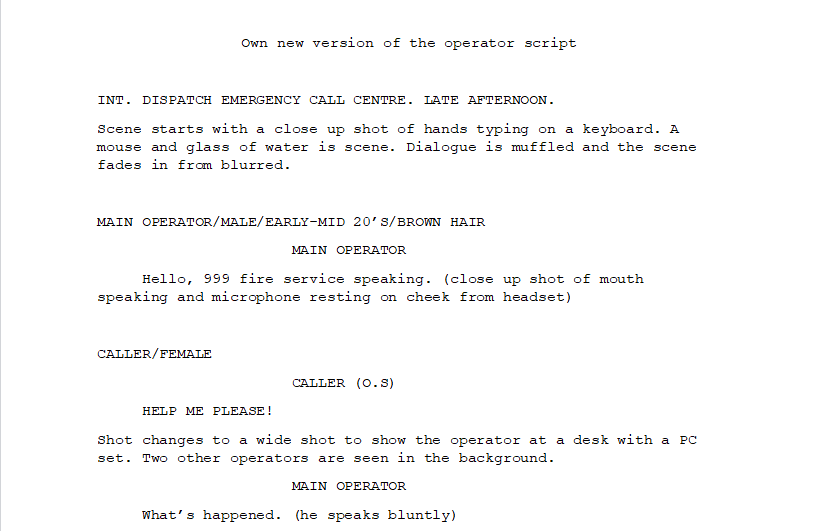
I started looking into script formatting by creating a script for the operator short film. I did this by watching a minute of the operator and using the format I had researched, began writing up what was going on.

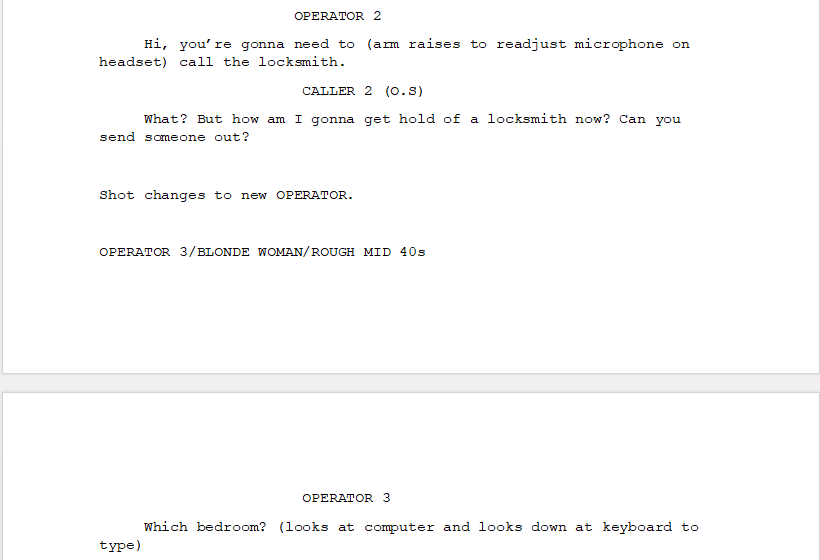


Next, I created a script for an operator-based story, taking the base that we follow in the operator however put a twist on it - putting more conflict into the story by changing the role of the character. I did this by having the operator be not as understanding as the operator in the actual short film and have the caller face increasing challenges and panic more than the caller in the film.


Stand By Me

By looking at the script for "Stand By Me" we can spot the key elements of the script format.
The first thing on the script is the 1 in the top right corner - this shows the page number. This is important because it maintains the order of the script pages. Next is the action line.


Stand by me was initially a book by Stephen King called "The Body". By comparing the screenplay to the original copy of the book, we can infer the differences made by the writers.
In the first page of the book, King uses a range of subject terminology to make the readers want to know who is the main character and what they are talking about. For example, when Gordon is narrating in the book, he uses a rhetorical question to reach out to the audience and to try and relate to them. In the screenplay, the writer has chosen not to use a rhetorical question, they go straight to the point of when Gordon was 12 he saw his first dead body. This decision could have been made to shock the audience, this is because seeing a dead body is quite rare and a such a young age too. This sets the vibe for the film, instead of easing into it, talking about other things like the book does. Compared to the script, the way scripts are formatted does not use subject terminology to explain plot like in the book, action lines and character lines are used to describe the same things.
In the same paragraph, the writer has decided to keep the dialogue the exact same as the speech in the book. They say "I was twelve going on thirteen when I first saw a dead human being. It happened in 1960, a long time ago...although sometimes it doesn't seem that long to me". By making this decision, the writer has shown a sense of continuity. This could be because when creating a film adaptation of a book, it is very common for the originality to be lost, however by keeping this the same, the audience can infer that they have worked hard to keep the hook early on like in the book, keeping the audience interested.
When discussing the treehouse in "The Body", King goes into heavy detail, getting the point across to the reader that the boys were often here as it was like a "social club". This adds to context points for the reader. However, in the screenplay, this is majority taken out, going straight to a change in scene and the characters in a conversation. This could have been done to create a seamless flow in the movie, however, this could be left with more questions for the reader.
Overall, there are differences in the book and the screenplay, this then creates differences within the film itself. Whilst the decisions made by the writer aren't drastic changes, the decisions made by the author and the writer have been made for a reason.
Comments