Script to storyboard
- charlotte2006lr
- Oct 13, 2023
- 6 min read
Updated: Dec 10, 2023
When creating films and TV shows we must do two things to make sure everyone knows what needs to happen and what is happening in the movie. By looking at a quiet place script, there is no dialogue being spoke so they must communicate through sign language, gestures and facial expressions. To convert the script to a story board I have to infer the script to different shot types and why I think it would be beneficial to use.
Firstly, I started by annotating the script with what each part was, what it meant, how it could be inferred and what shots could be used. This helped by seeing what the film is and what it could be made into. I am going to create a shot list from the script that I have annotated.
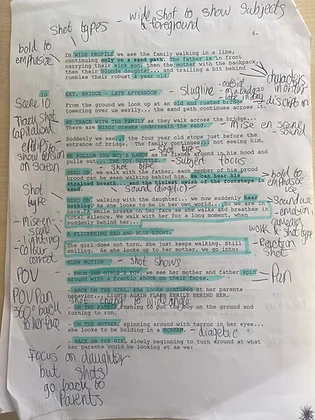
Shot List
Page 1 of the script in order:
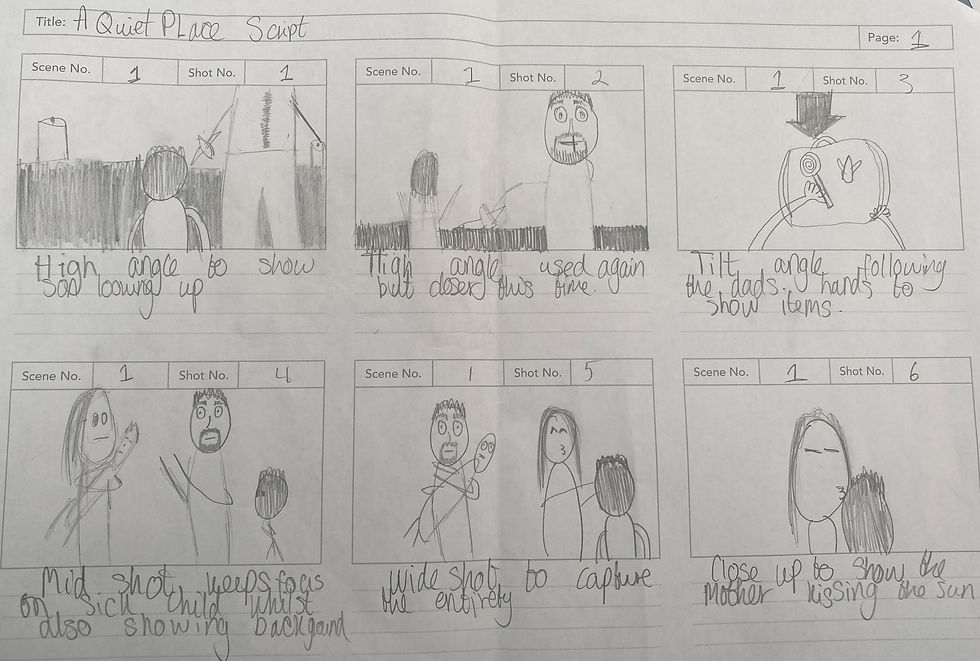
Starting off I want to use a high angle to represent the little boy looking up at his father putting his toy away. Looking up at him could represent how upset the little boy may feel over his father putting the toy on the cabinet. Then a Tilt shot to follow the fathers hand movements of picking up the big lollypop and putting it into the bag.
Next a Mid shot to show how the mother passes the sick younger sibling over to the father. This captures the young boy as he is the subject in the shot and how he is passed over from one character to the other.
To show the mother kissing the four-year-old on the head I would use a brief wide shot to capture the two characters and then switch to a close-up of the son's head to emphasize the love and care the two parents have for their son - this could potentially foreshadow his death as they not do get to say goodbye. This could then switch to having the son in the left-hand side of the shot in the foreground and have the mother walk behind him - losing the focus of the son to the mother who collects her bag and walks away.
Next I would use a medium shot to show the daughter looking at her brother. Then switch to a medium-full shot of the son. Then a medium full shot of the daughter who then signs to the brother. To show the son/brother shaking his head no I would use a high angle to look down at the boy as this shows he is powerless but still holds some form of power (that with the noisy toy he puts the rest of the family at risk).
I would use a wide shot to show the daughter looking around for the parents. I would use a tilt angle to show the daughter grabbing the toy (the movement follows the toy). Once again I would use a high angle to show the sister/ the daughter looking down at her brother/the youngest son. Then a low angle of him looking up at the sister. Then a close-up shot of her hands fiddling with the toy to get the battery out. I would use a medium close-up shot to show the son/brother moving around for the daughter/sister to (close up shot) put the toy in his hoodie. A headshot to show the sister/daughter signalling to the brother/son to keep it quiet that he had the toy. A headshot to show the son/brother happy that he had it. Then a close up of her gesturing them to go and a wide shot of them leaving.
That concludes the first scene from the script. Next I am going to create a storyboard for this scene.
My 4 storyboards show each rough shot. This shows who is in each shot, what they are doing, what props they might have (what will be needed on set) and in some cases a look into what characters might be wearing. Had I of used shading, I could have showed what lighting is used in the scene.


Now I have made a story board the first scene I will be comparing it with the scene itself and my shot decisions and why I decided to use them.
By watching this video, we can see the script for "A Quiet Place" following the real scene used in the movie itself.
I started my shots in the scene when the dad takes the toy off the little boy and places it on the counter, they film makers used a track close up, I used a low angle shot from behind the boy to relate the audience to the boy and show what he sees and how he feels. I then cut this scene to a high angle of the dad putting it down on the counter, showing that he is in control of the situation.
In the script, we were told that the dad puts the spaceship on the side and grabs a lollypop and puts it in a bag. This was not featured in the film. I chose a tilt shot, following the fathers hands - grabbing the bag and putting the lollypop into it. This may have been a better use compared to the film as it shows a little bit of emotion - that the boy is still a child and lollypops are something that are quite innocent towards children.
Again, the script explained to us that the mother hands the sick child over to the dad and this was not featured in the film. I did this on my storyboard by using a medium full shot, capturing mainly the sick sun and the movement of him from one parent to the other.
When the mother goes over to the little boy to comfort the boy, they have used a medium close up shot to capture the mothers movement towards the boy. I decided to use a close up of the back of the child's head and the mother kissing his head, mainly to capture the mothers emotion. I did this to contrast with the fact he could have been killed or made the family get killed due to his young age and not understanding that they must be completely quiet, but regardless of the fact the mother still has immense love for the child and wants him to know that.
When the mother walks off to collect her nag and leave they use a track/pan that then focusses on the child as she leaves. I did a similar thing to this when I wanted the son in foreground on the left hand side (1st third in the panel) in focus whilst we see the mother collect the bag and leave in the background - unfocused but clear enough to see. Then i wanted to cut to a wide shot of the son centered in the foreground and the mum leaving out the door. I did this as I wanted to represent how the child in alone.
When the sister is introduced in the scene, there is closeup shot of the sister and then the camera movement follows the toy. However I decided to break this up and have a medium shot of the brother and the sister left alone in the shop together and add a medium full shot of each character to emphasise the position of power each character is in. This sister is more responsible than the younger brother and the little brother wanted the toy so if his sister gave it to him then he would happily have it.
In the real scene the sister does not look around to see if the parents are there/ would notice whereas I added this from the script and put in a wide shot showing the context; the younger brother, the sister and the two parents and sick son walking outside which is visible in the shop.
THEN,I had the sister give the brother the toy, in the film this was almost instantaneous. I used a close up shot with the camera moving to follow the toy, just like the films use of this scene. However in the scene in the film she quickly checks the toy to make sure it is safe (no batterys in it) and this is shown in a wide shot where the character are featured in the left hand side. I changed this to a close up -really emphasising how life dependent they are on this toy not making noise.
In the script it is said that the sister puts the spaceship in the brothers hood, where as in the scene she just hands it to him. I storyboarded her putting it in his hood by using a medium close up shot. I also had thought about using a over the shoulder shot but decided I didn't think this would have the same effect.
I decided to use a similar shot of the close up they used in the film where the sister gestured to the boy to be quiet.
However, I slightly changed the order of the shots in the scene in my story board. I had it as there is a head shot of the boy seeming happy as he now had the toy he wanted. Then a close up or mid shot of the sister saying lets go and then they both leave. This is ordered slightly differently in the film.
Comments