Storyboarding
- charlotte2006lr
- Oct 10, 2023
- 2 min read
Updated: Oct 15, 2023
When creating film and TV, the writers and directors create storyboards to share their visions of what the shots will look like. They allow the director and storyboard artist to test what the movie will look like before filming. Arrows are used in storyboards to show how a person or object is moving (these are within the frame) and how the camera moves (these are outside the frame). Pans and tilts are shown with an arrow on the side of a panel to show the direction of movement. In some films that have a large amount of visual scenes (instead of lots of dialogue), sometimes a script is not needed but heavily relies on a storyboard. There are three types of storyboards; Thumbnail, Digital, and Traditional.
Traditional
Traditional story boards are created using drawings and sketches showing characters props and arrows used to show and represent camera, people and objects moving.

In this storyboard for Spiderman 2, the progression of the scene is showed through sketches. It shows Spiderman and Doc Ock fighting on the train. It uses arrows to show the direction the train and the character goes in. It uses a range of different angles and shot types to show the vision of the writer and director. Different levels of shading has been used to represent lighting and shadows that may be used.
Thumbnail
Thumbnail is used for showing storyboards without writing. These means that there is not always as much detail.

In this thumbnail storyboard we see that there are no arrows or word on the drawing themselves compared to the traditional one. On this example any notes to be made explaining what is happening is done in the notes section below. The more detail added the better as when it comes to shooting the scenes the actors know what the shot and scene itself looks like.
Digital
Digital storyboards are used to be shared and edited by teams of filmmakers. By drawing and sketching thumbnail or traditional storyboards, lots of time is used whilst you could have a simple version animated quickly. They are becoming more popular amongst modern filmmakers.
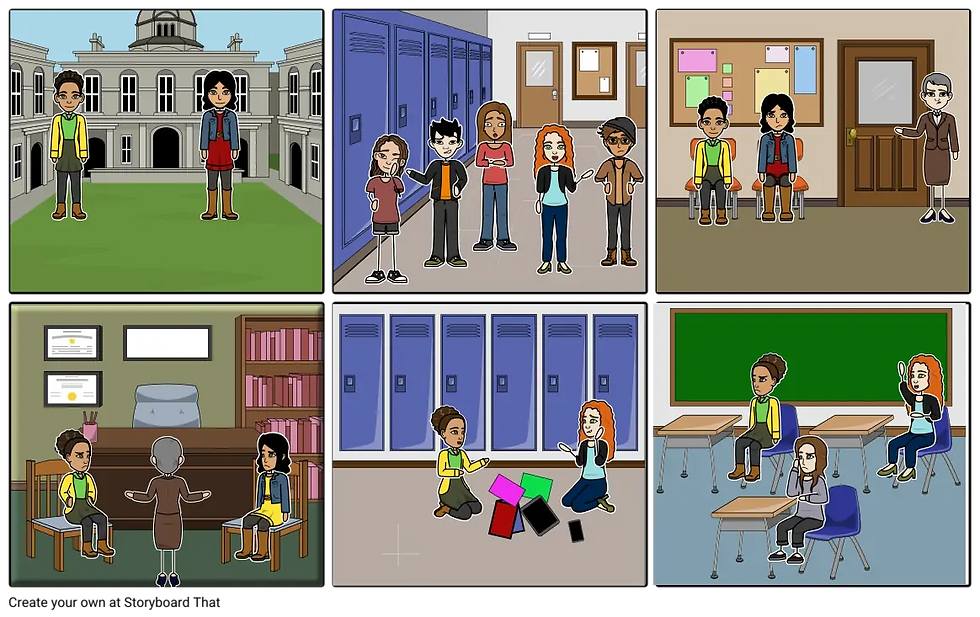
Digital storyboards can be simple by showing location, characters, props and scenes.
Analysing movie story boards
Looking at this story board from the "Do-re-mi" scene we can learn a range of things. Firstly, the director Robert Wise and the cinematographer has created a "thumbnail" story board. This means there is not an awful lot of detail towards camera movements, movements of subjects in the shot, shot types. It gives a brief overview of what the scene may feature and look like.

As this storyboard does not feature any angles it is left up to the script and director to clarify. With the use of color, we can infer that this was wanted to be filmed on a sunny and bright day - foreshadowing the fact this is a bright and happy scene. This could be compared to the use of dark pencil sketches to show lighting and contrast in traditional sketches. We can see that the director wants to use high angles, low angles, wide shots, and medium full shots. With these in the storyboard, the director can film them how he envisions them.
Comments