The Four Pillars
- charlotte2006lr
- Sep 14, 2023
- 3 min read
Updated: Sep 17, 2023
In photography, there are many things we can do to make a photo turn out a certain way. whether this be changing the depth of field so the background is blurred whilst the foreground is focused or changing the bokeh is the quality of out-of-focused objects. The four pillars are used to get a good photo with good quality.
The four pillars are; Aperture, Shutter speed, ISO, and White balance.
Aperture
Aperture is used to control how much light is let through the lens. This affects the focus of the image and the depth of field. Aperture is controlled by the hole in the lens of the camera.

The larger the lens is opened, the more light is passed through, this will result in a shallower depth of field, meaning something in the foreground will be focused whilst the background will be more blurry. This is an example of a photo with a shallow depth of field (a more open aperture).

A more closed aperture would result in a deep depth of field, this makes foregrounds and backgrounds clearer in comparison to photos using an open aperture. This is an example of a photo with a smaller aperture.

Aperture is measured in F stops. These are how we change the depth of field of an image, For having a brighter picture or more bokeh in an image we will decrease the F stop, meaning it will have a smaller number after the F and the aperture itself will be more open. For a darker image and more focus, we will increase the f stop, meaning it will have a larger number and the aperture itself will be more closed.

Shutter Speed
Shutter speed is used to describe how long the camera's sensor is exposed to light. It is used to take clearer pictures of moving images. For example, if something is moving quickly and unpredictably, we would use a high/fast shutter speed to freeze the image.

If we took the photo of the thing moving quickly and unpredictably on a low shutter speed we would get a motion blur effect.


ISO
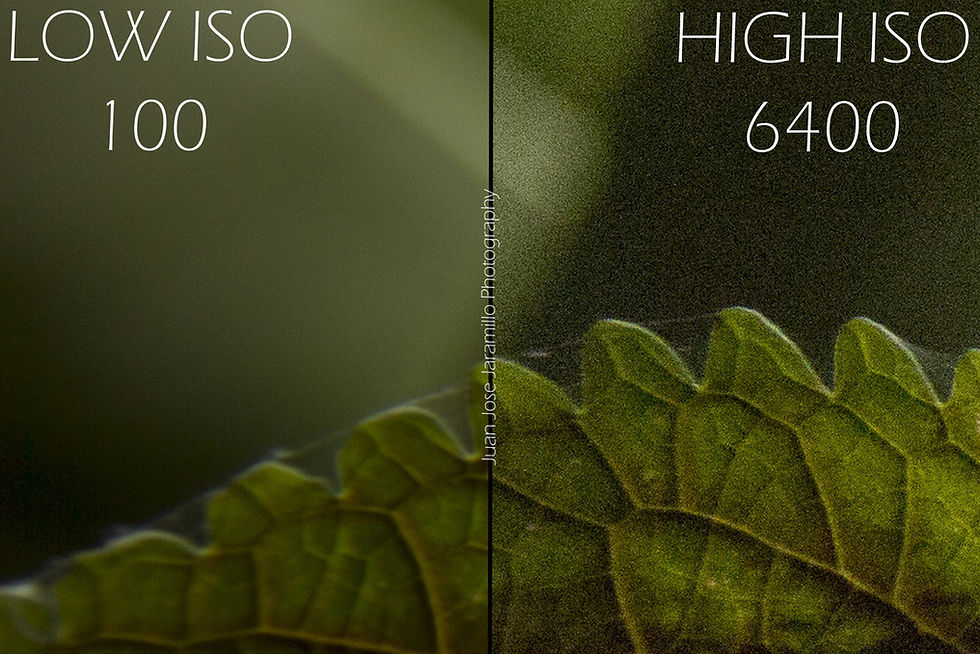
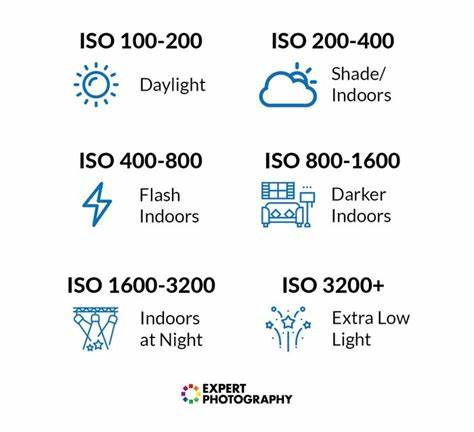
ISO is used to determine the light sensitivity on an image. When taking an image of something that is in a bright, well lit place or scenario we will use a lower ISO, typically 100. When taking a photo of something in a darker or poorly lit environment we will use a higher ISO, typically around 800 as when the ISO gets into 4 digit numbers the quality is lost due to more "digital noise" being shown. "Digital noise" is typically grain or pixels in photos.
This is a guide on what scenarios ISO may be changed for when taking images.
White balance
White balance is the final "pillar of photography". The colouring of images is important as it adds warmth and coldness to images and may even provide feeling to the picture.

We use white balance in cameras to tell the camera what is white and how that may affect other colours. The white balance is affected by lighting and what the sensor is picking up. For example, if we were shooting with fluorescent lighting, the image will have a cooler undertone, this will need to be changed so that the true colours are seen, unless a different colour theme is wanted.
We change the white balance by looking at what lighting conditions we are shooting in and change the kelvin scale on the camera to match .
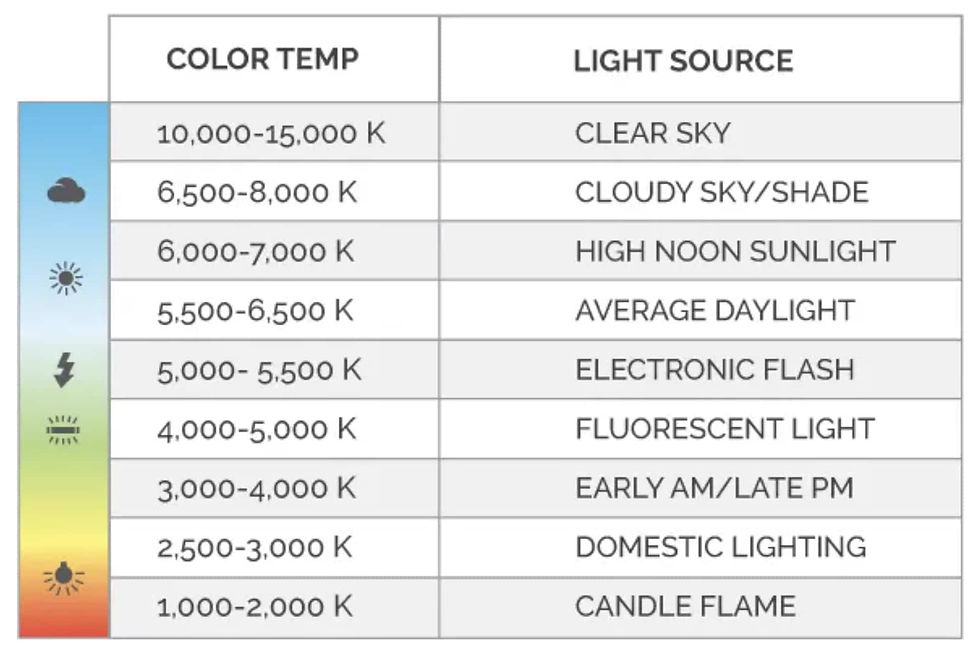
In conclusion, to get the perfect image we use the first three pillars Aperture, Shutter speed and ISO to get the perfect image. Changing the white balance can help smoothen the image to differ the colouring of the image.
Comments